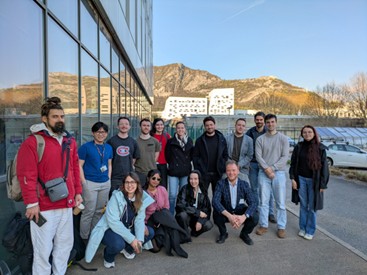
From March 17 to 20, 2026, scientists from CANVAS consortium took part in the Hackathon on Predictive Modeling in Systems Pharmacology, held at the French Alternative Energies and Atomic Energy Commission (CEA) in Grenoble, France.
The event was co-organized by experts from CEA, INRIA, CHU Limoges, and the Toulouse Cancer Research Center, and brought together researchers from the CANVAS and DIGPHAT (Digital Pharmacological Twins, funded by the France 2030 Digital Health program) consortia. Participants represented diverse scientific backgrounds, including pharmacology, bioinformatics, and computational biology, creating a highly interdisciplinary environment.
The hackathon was designed as an intensive, hands-on training initiative aimed at bridging the gap between theoretical knowledge and practical application in systems pharmacology.
Over the following three days, participants engaged in thematic modeling challenges:
Day 1: Pharmacokinetic and Pharmacodynamic Modeling – Focused on PK/PD modeling approaches applied to anti-tumor immunotherapy, enabling participants to explore drug behavior, dose–response relationships, and therapeutic dynamics.
Day 2: Network-Based Modeling of Targeted Therapies – dedicated to predicting the impact of targeted anti-cancer therapies using gene network modeling approaches, with an emphasis on systems-level understanding of drug mechanisms.
Day 3: Predictive Modeling in Pharmacogenomics – focused on the development of predictive models for patient response to anti-tumor immunotherapy, leveraging pharmacogenomic and transcriptomic data.
The program combined methodological lectures, software tutorials, and collaborative problem-solving sessions. Participants worked in rotating teams, encouraging cross-disciplinary exchange and maximizing knowledge transfer.
The hackathon resulted in the development of multiple predictive modeling strategies and significantly strengthened participants’ competencies in computational pharmacology, data integration, and predictive analytics. Feedback collected after the event highlighted a high level of satisfaction, particularly regarding the scientific quality and collaborative format, with suggestions to further increase hands-on components in future editions.
Participation in this hackathon marks an important step in building expertise within the CANVAS project, supporting the dissemination of advanced modeling approaches and fostering innovation in precision medicine.